

 There are many cutting edge battery technologies that have yet to be seen by the general public. The future of battery electric vehicles depends primarily upon the cost and availability of batteries with high energy densities, power density, and long life. Li-ion, Li-poly and zinc-air batteries have demonstrated energy densities high enough to deliver range and recharge times comparable to conventional vehicles.
In 2008, Lawrence Berkeley National Laboratory developed a carbon nanotube lead acid battery pack that, according to the company, can deliver 380 miles (610 km) range and can be recharged in less than 10 minutes. This technology extends current battery life times 4-fold.
Lead-acid batteries are the cheapest and most common traction batteries available, but these have an environmental impact through their construction, use, disposal or recycling. Lead-acid batteries have an energy density of 30–40 Wh/kg. The efficiency (70–75%) and storage capacity of the current generation of common deep cycle lead-acid batteries decreases with lower temperatures, and diverting power to run a heating coil reduces efficiency and range by up to 40%. Lead-acid batteries in EV applications also take up a significant (25–50%) portion of the final vehicle mass.
Nickel-metal hydride batteries are now considered a relatively mature technology. While less efficient (60–70%) in charging and discharging than even lead-acid, they boast an energy density of 30–80 Wh/kg, far higher than lead-acid. When used properly, nickel-metal hydride batteries can have exceptionally long lives, as has been demonstrated in their use in hybrid cars and surviving NiMH RAV4EVs that still operate well after 100,000 miles (160,000 km) and over a decade of service. Downsides include the poor efficiency, high self-discharge, very finicky charge cycles, and poor performance in cold weather.
Lithium-ion batteries have an impressive 200+ Wh/kg energy density and good power density, and 80 to 90% charge/discharge efficiency. In 2008, the DOE’s Argonne National Laboratory received an award for EnerDel/Argonne High-Power Lithium-Ion Battery for Hybrid Electric Vehicles. This highly reliable and extremely safe battery is lighter in weight, more compact, more powerful and longer lasting than the nickel-metal hydride (Ni-MH) batteries.
Lawrence Berkeley National Laboratory developed a Nanostructured Polymer Electrolyte for Rechargeable Lithium Batteries. This polymer electrolyte battery enables the development of rechargeable lithium metal batteries with an energy density that is high enough “to enable electric battery-driven transportation technology”.
Newer forms of lithium-ion batteries have an energy storage capacity of 400 kWh and they are used in applications like electric Autonomous Underwater Vehicles (AUVs). Most EVs are now using new variations on lithium-ion chemistry to provide fire resistance, environmental friendliness, very rapid charges and very long lifespans.
A lithium iron phosphate battery developed by A123 lasts for at least 10+ years and 7000+ charge cycles, and LG Chem has a lithium-manganese spinel battery that last up to 40 years. Bolloré a French automotive parts group developed a concept car the “Blue car” using Lithium metal polymer batteries developed by a subsidiary Batscap. It has a range of 250 km and top speed of 125 km/h.
Efforts are ongoing to improve lithium ion batteries. Lithium vanadium oxide has already doubled energy density. Silicon nanowires, silicon nanoparticles, and tin nanoparticles promise several times the energy density, while composite and superlattice cathodes also promise significant density improvements.
A new company, Ampirus, is bringing to market a lithium-ion battery that is 40% more efficient than the current generation.
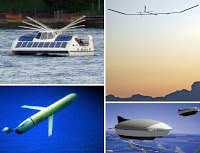
These new battery technologies are not only in the lab. Manned aircraft already use very thin, wide area traction batteries. Third generation traction batteries such as lithium-sulphur are being successfully used today in Unmanned Aerial Vehicles (UAVs).
New battery technologies are being applied in conjunction with solar power. Companies like SolarLab and Monte Gisborne are producing battery powered solar boats that have been around for a while. New, very flexible copper indium gallium diselenide CIGS solar cells are now powering solar boats such as those made by Kopf Solarschiff GmbH. Solar dirigibles are a perfect candidate for the new flexible photovoltaics.
The more efficient batteries are the less expensive and more user-friendly these products will be. In April 2011, US Energy Secretary Steven Chu talked about the future of electric cars and indicated that he believes that before the end of the decade EVs will be “one-third the cost of today’s batteries but have at least three times the range.” He also said it will be possible for vehicles to travel up to 500 miles on a single charge.
President Obama has called for one million EVs on American roads by 2015. Conservative estimates in a 2010 report by J. D. Power, predict EV sales in Europe to be 742,020 units, or 3.1 percent of 23.8 million sales by 2020. China is predicted to see EV sales of 332,775 or 1.9 percent market share by 2020. However, J.D. Power’s predicted 2020 global market share for EVs is far lower than the 10 percent or 6 million units forecast by Renault-Nissan CEO Carlos Ghosn.
According to an IDTechEx report by Dr Peter Harrop and Raghu Das, “Electric vehicles will penetrate the market rapidly to constitute 35% of the cars made in 2025 – probably 25% hybrids, 10% pure EV but pure EV may be winning by then. Any motor manufacturer without a compelling line up of electric vehicles is signing its death warrant.”
With the market for automobile traction batteries that is sure to surpass the early prediction of $37 billion in 2020, many of these advanced battery technologies will eventually find their way into commercial vehicles that are widely available to the public.
© 2011, Richard Matthews. All rights reserved.
Related Posts
Improving Battery Technology Key to Greener Cars
Electric Vehicle Battery Technology Obstacles and Solutions
Energy Storage
Discover more from Change Oracle
Subscribe to get the latest posts sent to your email.


