
Saturday, October 31, 2026
Change Oracle Logo
  • Climate Change
    • Greenhouse Gas Emissions
    • Biodiversity
    • Extreme Weather
  • Energy
    • Renewables
    • Nuclear Power
    • Fossil Fuels
  • Politics
    • American Politics
    • Canadian Politics
    • International Politics
  • Social Change
    • Activism
    • Disinformation
    • Education
    • Psychology
    • Gender Equality
  • Business and Economics
    • Leadership
    • Decarbonization
    • Economics
    • Supply Chains
    • Investing
  • Technology
    • Carbon Removal
    • Carbon Capture
    • Transportation
    • Buildings & Infrastructure
    • Food
  • Polycrisis
No Result
View All Result
Change Oracle Logo
No Result
View All Result
Home Business and Economics Leadership

Review of Five Socially Minded Legal Forms for Companies

by Change Oracle
May 30, 2012
in Leadership
0

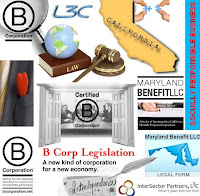
There are a host of different legal options and requirements for companies who wish to be socially engaged. As reviewed in a May 25 Forbes article, here is a summary of five legal forms available to socially-minded companies. They include Benefit Corporations, California’s Flexible Purpose Corporations, Maryland Benefit LLC, L3Cs and B Corporations:

1. Benefit Corporations

This is a new class of corporation, pioneered by the Berwyn, Pa-based nonprofit B Lab. B Lab is a nonprofit organization dedicated to using the power of business to solve social and environmental problems.

It is already law in seven states most recently Illinois and Louisiana. This legislation mandates that companies and their boards take into account public benefits that impact society and the environment when making decisions. These companies also have to issue an annual third party audit report that addresses their social and environmental goals.

The goal is to give companies legal protection to take certain steps that benefit their non-financial objectives, even if it’s not so good for the bottom line. It is also reassuring to shareholders who are looking for greater corporate responsibility from the companies they invest in.

For more information on Benefit Corporations click here.

2. California’s Flexible Purpose Corporations

This was passed into law in California last October. Flexible Purpose Corporations also allows for Benefit Corporations. Flexible Purpose Corporations, unlike the Benefit variety, don’t have to meet general public benefits. Instead, they can specify at least one “special purpose”–addressing environmental sustainability, for example, or building a park. So the social focus is a lot more narrowly defined than it is with Benefit Corporations.

Ultimately, the Flexible Purpose is designed for larger, more traditional companies that want to consider matters other than the financial bottom line, but aren’t “mission driven at their core,” according to Heather Van Dusen, a senior associate at B Lab.

For more information about Flexible Purpose Corporations click here.

3. Maryland Benefit LLC

 In addition to allowing for Benefit Corporations, Maryland also permits companies to do the same thing but as a Limited Liability Company. That way, businesses already registered as LLCs don’t have to convert over to a corporate structure.

The designation was created by legislation signed on May 19 by Gov. Martin O’Malley. The new law protects benefit LLCs from lawsuits by their members if they make decisions that put the environment, community, or social causes over making a profit. It is aimed at firms that want to make social activism part of their corporate mission.

For more information about Maryland Benefit LLC click here.

4. L3Cs

They’re low-profit limited liability companies with a charitable or educational purpose. There are about 600 such companies in nine states.

Proponents created L3Cs to be entities that can be treated as Program Related Investments (PRIs) by foundations. By law, foundations have to direct 5% of their assets to charitable purposes every year. They can do that through PRIs, as long as the organization they’re investing in has a charitable or educational purpose and doesn’t include making a profit as a significant goal. Plus, for-profit investors can put money into an L3C and, as a result, companies potentially can attract considerably more funding.

Foundations have been slow to adopt PRIs. But, with new rulings from the IRS, that could change soon.

For more information about L3Cs click here.

5. B Corporations

This isn’t a corporate structure, even though that word is in the name. It’s a certification from B Lab, which rates triple-bottom-line companies. (Think of Fair Trade USA, which certifies Fair Trade companies). Started in 2007, there are now 530 such businesses. Ratings cover five areas–society, environment, employees and so on–with 130 to 180 factors depending on company size and industry. Businesses have to score over 80 out of a total of 200 points. There also are unannounced audits of about 10% of all certified companies every year.

For more information about B Corporations click here.

© 2012, Richard Matthews. All rights reserved.


Discover more from Change Oracle

Subscribe to get the latest posts sent to your email.

Share
Previous Post

EPA’s Carbon Pollution Standard has Strong Support

Next Post

Former Environment Canada Employee on Harper’s Conservative Government

Change Oracle

Change Oracle

Richard Matthews is a researcher, writer, journalist, consultant, and change activist. He has published thousands of articles and contributed to reports for policymakers including a United Nations Environment Program (UNEP) publication. His critical, interdisciplinary analyses have been cited by a wide array of academic publications. His research interests include carbon removal, nuclear power, and disinformation. He is currently spearheading Change Oracle’s Polycrisis Project (COPP).

Related Posts

The War on Science Is a War on Reality

by Change Oracle
October 5, 2026
0

Science is supposed to be one of the places where political power stops. A president can make a claim, a political party can promote an ideology, a billionaire can fund...

trump voter suppression

Trump’s Voter Suppression Machine is Rigging the 2026 Midterm Elections

by Change Oracle
August 31, 2026
0

The greatest threat to election security is not coming from Russia, China or Iran, it is coming from within the Whitehouse. U.S. President Donald Trump has leveraged the powers of...

climate change and heat waves in the summer 2026

Unrelenting Global Heat: How Rising Temperatures Are Collapsing Terrestrial and Marine Ecosystems

by Change Oracle
July 20, 2026
0

The trajectory of planetary heating has escalated at an alarming rate, transforming what were once considered extreme anomalies into a harrowing baseline reality. With greenhouse gas emissions continuing to rise,...

Next Post

Former Environment Canada Employee on Harper's Conservative Government

Leave a Reply Cancel reply

Subscribe on Substack

Follow Change Oracle

  • Spotify
  • Facebook
  • LinkedIn
  • YouTube
  • Instagram
  • TikTok
  • Email

Podcasts

American Politics

The War on Science Is a War on Reality

by Change Oracle
October 5, 2026
0

Science is supposed to be one of the places where political power stops. A president can make a claim, a...

Read moreDetails
trump voter suppression

Trump’s Voter Suppression Machine is Rigging the 2026 Midterm Elections

August 31, 2026
climate change and heat waves in the summer 2026

Unrelenting Global Heat: How Rising Temperatures Are Collapsing Terrestrial and Marine Ecosystems

July 20, 2026

The Iran War as a Polycrisis Case Study

June 22, 2026

Chainsaw Governance: What is Behind the Administration’s Purge of Federal Employees

May 4, 2026
  • About
  • Podcasts & Videos
  • Climate Change
  • Energy
  • Business and Economics
  • Politics
  • Technology
  • Social Change
  • Polycrisis
  • Other

© 2024 Copyright Change Oracle.

Welcome Back!

Login to your account below

Forgotten Password?

Retrieve your password

Please enter your username or email address to reset your password.

Log In
No Result
View All Result
  • Polycrisis
  • Business and Economics
    • Leadership
    • Supply Chains
  • Economics
  • Energy
    • Renewables
    • Nuclear Power
    • Fossil Fuels
  • Climate Change
    • Greenhouse Gas Emissions
    • Biodiversity
    • Extreme Weather
  • Investing
  • Politics
    • American Politics
    • Canadian Politics
    • International Politics
  • Technology
    • Buildings & Infrastructure
    • Carbon Capture
    • Food
    • Transportation
  • Social Change
    • Education
    • Activism
    • Psychology

© 2024 Copyright Change Oracle.

Discover more from Change Oracle

Subscribe now to keep reading and get access to the full archive.

Continue reading