
Friday, May 8, 2026
Change Oracle Logo
  • Climate Change
    • Greenhouse Gas Emissions
    • Biodiversity
    • Extreme Weather
  • Energy
    • Renewables
    • Nuclear Power
    • Fossil Fuels
  • Politics
    • American Politics
    • Canadian Politics
    • International Politics
  • Social Change
    • Activism
    • Disinformation
    • Education
    • Psychology
    • Gender Equality
  • Business and Economics
    • Leadership
    • Decarbonization
    • Economics
    • Supply Chains
    • Investing
  • Technology
    • Carbon Removal
    • Carbon Capture
    • Transportation
    • Buildings & Infrastructure
    • Food
  • Polycrisis
No Result
View All Result
  • Climate Change
    • Greenhouse Gas Emissions
    • Biodiversity
    • Extreme Weather
  • Energy
    • Renewables
    • Nuclear Power
    • Fossil Fuels
  • Politics
    • American Politics
    • Canadian Politics
    • International Politics
  • Social Change
    • Activism
    • Disinformation
    • Education
    • Psychology
    • Gender Equality
  • Business and Economics
    • Leadership
    • Decarbonization
    • Economics
    • Supply Chains
    • Investing
  • Technology
    • Carbon Removal
    • Carbon Capture
    • Transportation
    • Buildings & Infrastructure
    • Food
  • Polycrisis
No Result
View All Result
Change Oracle Logo
No Result
View All Result
Home Technology Buildings & Infrastructure

Three Types of Cool Roofs

by Change Oracle
July 25, 2012
in Buildings & Infrastructure
0

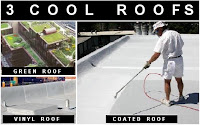
Cool roofs fall into one of three categories: roofs made from inherently cool roofing materials, roofs made of materials that have been coated with a solar reflective coating, or green planted roofs. While green roofs are in many ways the best, they are also the most difficult to construct and maintain. Inherently cool roofs like vinyl are relatively easy to install, while the easiest and in this respect the best cool roof is a coated roof.

Inherently cool roofs

White vinyl roofs, which are inherently reflective, achieve some of the
highest reflectance and emittance measurements of which roofing materials are
capable. A roof made of thermoplastic white vinyl, for example, can
reflect 80 percent or more of the sun’s rays and emit at least 70% of the solar
radiation that the building absorbs. An asphalt roof only reflects between 6 and
26% of solar radiation, resulting in greater heat transfer to the building
interior and greater demand for air conditioning.

Coated roofs

An existing (or new) roof can be made reflective by applying a solar
reflective coating to its surface. The reflectivity and emissivity ratings for
over 1000 reflective roof products can be found in the CRRC (Cool Roofs Rating Council) website.

Green roofs

Green roofs provide a thermal mass layer which helps reducing the flow of
heat into a building. The solar reflectance of green roofs varies depending on
the plant types (generally 0.3-0.5).Because of the lower solar reflectance, green roofs reflect less sunlight and absorb more solar heat than white roofs. The absorbed heat in the green roofs is trapped by the greenhouse effect and then cooled by evapotranspiration.

© 2012, Richard Matthews. All rights reserved.

Related Posts
The Effectiveness of Cool Roofs in Hot and Cold Climates
The Benefits of Cool Roofs

20 Cool Roof Resources from the CRRC and Other Sources

Cool Roof Savings Calculators

Green Buildings Offer Many Benefits
The Extraordinary Growth of Green Building
The Implications of the Growth of Green Buildings
Green Building Environmental Benefits
Green Building Economic Benefits
Green Building Social Benefits
Green Buildings Resouces
Green Buildings Combat Climate Change
Green Buildings Health and Performance Benefits Part 1
Green Buildings Health and Performance Benefits Part 2
Green Buildings: The Many Benefits of Natural Lighting
Green Buildings: The Many Benefits of Ventilation
The Future of Green School Buildings
Top 10 Green Building Trends for 2010
25 Blogs Leading the Sustainable Building Revolution


Discover more from Change Oracle

Subscribe to get the latest posts sent to your email.

Share
Previous Post

Complimentary Webcast on Integrated Reporting: Achieving Value with Financial Grade Sustainability Data

Next Post

Cool Roofs Savings Calculators

Change Oracle

Change Oracle

Richard Matthews is a researcher, writer, journalist, consultant, and change activist. He has published thousands of articles and contributed to reports for policymakers including a United Nations Environment Program (UNEP) publication. His critical, interdisciplinary analyses have been cited by a wide array of academic publications. His research interests include carbon removal, nuclear power, and disinformation. He is currently spearheading Change Oracle’s Polycrisis Project (COPP).

Related Posts

Chainsaw Governance: What is Behind the Administration’s Purge of Federal Employees

by Change Oracle
May 4, 2026
0

The Trump administration has fired senior officials and hundreds of thousands of civil service employees throughout the government. This purge removed some of the most capable federal employees and replaced...

Feedback Loops and the Polycrisis: Interconnected Systems From Doom Loops to Virtuous Cycles

by Change Oracle
March 23, 2026
0

An ever-expanding web of feedback loops is converging to generate system-wide risks—collectively known as the polycrisis. The cascading effects of interconnected crises represent the collision of four deeply intertwined systems:...

Welcome to the Polycrisis: Earth’s Life-Support Systems Are Failing as We Cross Planetary Boundaries and Approach Climate Tipping Points

by Change Oracle
February 2, 2026
0

Listen as a podcast Earth’s life-support systems are failing.  Humanity is surpassing critical environmental thresholds and increasing the risk of triggering irreversible climate tipping points. It is hard to overstate...

Next Post

Cool Roofs Savings Calculators

Leave a ReplyCancel reply

Subscribe on Substack

Follow Change Oracle

  • Spotify
  • Facebook
  • LinkedIn
  • YouTube
  • Instagram
  • TikTok
  • Email

Podcasts

Change Oracle’s Polycrisis Project

Feedback Loops and the Polycrisis: Interconnected Systems From Doom Loops to Virtuous Cycles

by Change Oracle
March 23, 2026
0

An ever-expanding web of feedback loops is converging to generate system-wide risks—collectively known as the polycrisis. The cascading effects of...

Read moreDetails

Welcome to the Polycrisis: Earth’s Life-Support Systems Are Failing as We Cross Planetary Boundaries and Approach Climate Tipping Points

February 2, 2026

The Best Good Environmental News Stories of 2025

January 12, 2026

Change Oracle on Substack

January 5, 2026

COP30: Another Climate Summit Undone by Fossil Fuels

December 8, 2025
  • About
  • Podcasts & Videos
  • Climate Change
  • Energy
  • Business and Economics
  • Politics
  • Technology
  • Social Change
  • Polycrisis
  • Other

© 2024 Copyright Change Oracle.

Welcome Back!

Login to your account below

Forgotten Password?

Retrieve your password

Please enter your username or email address to reset your password.

Log In
No Result
View All Result
  • Business and Economics
    • Leadership
    • Supply Chains
  • Economics
  • Energy
    • Renewables
    • Nuclear Power
    • Fossil Fuels
  • Climate Change
    • Greenhouse Gas Emissions
    • Biodiversity
    • Extreme Weather
  • Investing
  • Politics
    • American Politics
    • Canadian Politics
    • International Politics
  • Technology
    • Buildings & Infrastructure
    • Carbon Capture
    • Food
    • Transportation
  • Social Change
    • Education
    • Activism
    • Psychology

© 2024 Copyright Change Oracle.

Discover more from Change Oracle

Subscribe now to keep reading and get access to the full archive.

Continue reading

Discover more from Change Oracle

Subscribe now to keep reading and get access to the full archive.

Continue reading